

- Profile
- Landscape design
Landscape Architecture
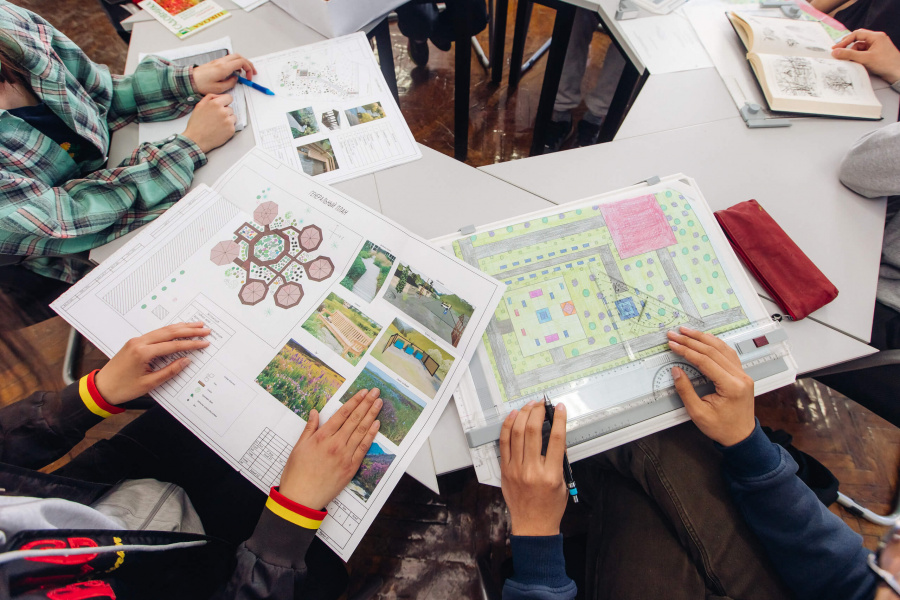
Specialists are involved in planning plots, parks and gardens, planning flowerbeds, designing lawns, ponds, and fountains. Students simultaneously receive classical architectural and biology and geodesy training. They study art and architectural history, engineering graphics, painting, drawing, and drafting, as well as biology, plant science, horticulture, and landscape views. Specialists in landscape architecture are successfully employed by government organizations (various architectural committees, supervisory agencies, gardening departments) and private companies.
Entrance examinations
The organization conducts entrance examinations in person and (or) using distance technologies (subject to the identification of applicants in passing their entrance examinations).
Schedule of entrance examinations
Course duration and fees
Tuition-free studying
Places available
- Full-time studying – 17;
- Part-time studying – 10.
Duration of the course
- Full-time studying – 4 years;
- Part-time studying– 5 years.
Full-fee studying
Places available
- Full-time studying – 10;
- Part-time studying – 5.
Duration of the course
- Full-time studying – 4 years;
- Part-time studying – 5 years.
Tuition per year (2023)
- Full-time studying – 45 000 to 80 000;
- Part-time studying – 45 000 to 80 000.
During your studies you will obtain
Essential skills
-
implementation of professional activities in the field of development and implementation of a system of measures for external landscaping and planting of territories to create favorable sanitary and hygienic conditions;
-
participation in works on preservation of green plantings of high nature protection value, on provision of their environment-forming, water-protective, protective, sanitary-hygienic and other useful functions;
-
mastering the methods of modern technologies of growing planting material: ornamental trees and shrubs, flower crops, lawns.
Material and technical base
- Four classrooms are used for training: one computer lab for 14 computers, one lecture room and two classrooms for practical classes;
- for teaching landscape design, training software AutoCad, Sketchap, Lumion, Aboveillustator is used.

Future career
After graduation, you will be able to
Graduates of Landscape Architecture can realize their potential in professional and creative activities both in Russia and abroad. They can design public urban spaces: parks, public gardens, squares; landscaping of streets; landscaping of private territories; creation of urban art objects and installations; landscaping in interiors, development of roof gardens, phyto-design. Specialists in the field of landscape architecture can be employed in: design-bureau, architectural firms, educational institutions, government agencies, etc.

Our Partners

Professors

Bessmolnaya Margarita Yakovlevna
Associate Professor, Candidate of Biological Sciences
Research interests:
- Study of ornamental crops (herbaceous, woody and shrubby) in the context of their use in floristics, floriculture, phytodesign and landscaping.
Vasilyeva Natalia Aleksandrovna
Senior Lecturer
Research interests:
- Variety and breeding of berry crops;
- Development of technologies for multiplication and cultivation of fruit crops;
- Berry and ornamental crops;
- Production of planting material.
Dorzhieva Alima Sergeevna
Acting Head of the Department, Associate Professor, Candidate of Biological Sciences
Area of research interests:
- Ecology;
- Ornithology (bird migration monitoring).
Dymchikova Marina Sergeevna
Senior Lecturer
Area of research interests:
- Architecture
- Urbanism
- Urban landscaping
- Sustainable perennials for urban flower beds

Imeskenova Erzhenna Gavrilovna
Vice-Rector for Educational Work and Youth Policy, Associate Professor, Candidate of Agricultural Sciences
Area of Scientific Interest:
- Natural hayfields and pastures
- Rural and ecological tourism
Manhanov Arsalan Dashevich
Dean of the Faculty of Agronomy, Associate Professor, Candidate of Agricultural Sciences
Research interests:
- Introduction of native perennial herbaceous plants in the system of landscaping of settlements,
- Economic and ecological justification of introduction of native perennial herbaceous plants of the Baikal region flora.
Tatarnikova Valentina Yurievna
Associate Professor, Candidate of Biological Sciences
Area of research interests:
- Landscaping;
- Landscape design;
- Landscaping of residential areas.
Chiripov Amgalan Vadimovich
Assistant
Area of research interests:
- Ecology;
- Environmental safety;
- Ecological monitoring;
- Sustainable development of rural areas.